


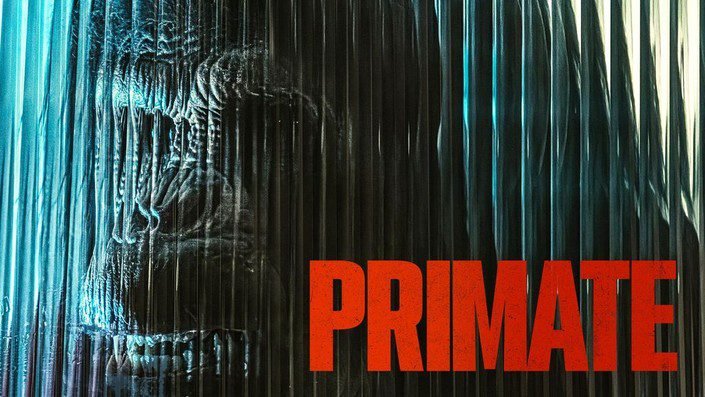
The Quick Verdict: Primate is a brutal, high-tension survival horror that successfully ditches CGI for visceral, practical effects. Johannes Roberts delivers his most claustrophobic work yet, anchored by a heartbreaking and physically demanding performance from Troy Kotsur. It is the definitive “nature-gone-wrong” film of the decade. Score: 4.5/5 Stars.
The Premise: A “Silent” Homecoming Turned Primal
In my experience covering natural horror, films often struggle to make the transition from “cute pet” to “deadly monster” feel earned. Primate (2026) avoids this trap by leaning into the emotional architecture of the family first.
The story follows Lucy (Johnny Sequoyah) returning to her family’s architecturally stunning, cliff-carved Hawaiian mansion. Waiting for her is her father, Adam (Academy Award winner Troy Kotsur), and Ben—the family’s highly intelligent, adopted chimpanzee. Ben isn’t just a pet; he was the crown jewel of Lucy’s late mother’s linguistics research, a “brother” who communicates through a custom soundboard and sign language.
What I found most striking was the “ticking-clock” mechanic. When a rabid mongoose infiltrates Ben’s enclosure, the film doesn’t wait for a slow burn. It establishes a 48-hour rabies window, transforming a beloved family member into an unstoppable, biological slasher.
Technical Specs: At a Glance
| Attribute | Detail |
| Director | Johannes Roberts |
| Cinematographer | Stephen Murphy (Shot on Sony VENICE 2) |
| Practical FX | Millennium FX (UK) |
| Locations | Madeira Island (doubling for Hawaii) |
| Runtime | 89 Minutes |
| Aspect Ratio | 2.39:1 (Anamorphic) |
Johannes Roberts’ Directorial Style Evolution: From Sharks to Simians
Having followed Johannes Roberts from his early days through 47 Meters Down and The Strangers: Prey at Night, his evolution in Primate is palpable. In the 47 Meters Down franchise, Roberts mastered the “unseen terror”—the dread of what might be lurking in the murky blue.
In Primate, he pivots to the “too-visible” terror. Ben the Chimp is rarely hidden; he is a physical, heavy presence that occupies the frame with terrifying certainty. While his Resident Evil reboot felt hampered by CGI constraints, Primatefeels liberated by its limitations. Roberts uses the Sony VENICE 2’s low-light capabilities to turn the “paradise” of a glass-walled mansion into a fishbowl where the characters are constantly watched. It is a more mature, focused version of the claustrophobia he explored in the shark cage, now applied to a sprawling, high-tech home.
The Sensory Experience: The Sound of Silence
Because Adam (Troy Kotsur) is deaf, the sound design in Primate is a character in itself. I was particularly impressed by how Roberts weaponizes silence. There are sequences where the audio drops entirely to mirror Adam’s perspective, forcing the audience to rely on visual cues—the subtle ripple of water in the pool or the shadow of a chimp moving behind frosted glass.
The Soundboard as a Weapon
The “Soundboard” Ben uses is the film’s most haunting element. Initially, the robotic, pre-recorded phrases like “Hungry”or “Play” are endearing. However, as the rabies takes hold, the audio distorts. The soundboard becomes a tool for psychological warfare. There is a chilling moment where Ben, lurking in the rafters, repeatedly presses the “Love Lucy”button while preparing to strike. It is a subversion of communication that feels both modern and deeply unsettling.
Primate (2026): Practical Effects vs. CGI
For the die-hard horror fans, the headline here is Millennium FX. Eschewing the digital “uncanny valley” seen in many recent blockbusters, Roberts cast movement specialist Miguel Torres Umba to play Ben in a suit.
Why the “Man-in-Suit” Outperforms CGI:
- Physicality: Unlike a digital asset, Umba’s Ben has actual weight. When he jumps onto a table or slams against a door, the set reacts. The actors aren’t screaming at a tennis ball on a stick; they are reacting to a 5-foot-tall, muscular predator.
- The “Uncanny” Factor: Millennium FX (known for their work on District 9 and various Doctor Who monsters) created multiple animatronic heads. The micro-expressions in Ben’s brow and the “citrus-pectin” foam used for rabid saliva look disturbingly real under the Hawaiian sun.
- The Mirror Rig: During the climax, Roberts used a motor-driven mirror rig to fracture the visuals in-camera. Combined with the practical suit, it creates a disorienting, “hallucinatory” horror that CGI simply cannot replicate with the same grit.
Comparison: The Rabid Animal Hierarchy
| Movie | The Catalyst | Tone | Survival Level |
| Cujo (1983) | Bat/Rabies | Gritty/Isolated | 9/10 |
| Nope (2022) | Gordy’s Trauma | Surreal/Societal | 7/10 |
| Primate (2026) | Mongoose/Rabies | Tech-Terror/Slasher | 10/10 |
Is Primate (2026) too violent for kids?
Technically, the film is rated R (or MA 15+) for “strong blood and gore.” This is not a “fun animal movie.” Roberts leans into the “mean” horror aesthetic. From the opening sequence where a veterinarian has his jaw torn off to the “Pool Sequence” involving a shovel, the violence is visceral. It is intended for mature horror audiences who appreciate practical gore.
How does Troy Kotsur’s performance change the horror genre?
Kotsur’s involvement is a game-changer. He doesn’t just play a “victim who can’t hear”; he uses his entire body to convey a father’s heartbreak. Every sign-language gesture feels heavy with the weight of a lost “son.” It forces the horror genre to move away from “jump scares based on loud noises” and toward a more visual, tension-based dread.
The Final Verdict & Who It’s For
While Primate excels technically, it isn’t perfect. I found that the “college friends” who arrive for the party feel like mere fodder—their character arcs are non-existent, and they exist primarily to showcase Millennium FX’s gore capabilities. However, the core trio of Lucy, Adam, and Ben is so strong that these minor flaws are easily overlooked.
Who should watch this?
- Fans of “throwback” horror like Cujo.
- If you enjoyed the claustrophobia of The Strangers (also directed by Roberts).
- Anyone tired of the “CGI-slop” in modern creature features.
Primate is a “throwback” in the best way possible—a neon-drenched, synth-heavy, and gore-soaked exploration of the thin line between the living room and the jungle.
Join the Conversation
Do you think practical effects are always better than CGI in horror movies? Or did the “man-in-suit” approach feel too retro for you? Let me know in the comments below!